
What Is Cost Segregation? A Beginner’s Guide to Cost Segregation Studies
Download the PDFIf you’ve bought, built, or renovated a property, you may be sitting on a tax opportunity without knowing it. A cost segregation study is a tool property owners use to speed up depreciation deductions, improve cash flow, and lower their tax bill in the early years of owning a building. But what is cost segregation, exactly, and how does it work? This guide breaks it down in plain English. Think of it as cost segregation for dummies: no accounting degree required.
What Is Cost Segregation?
When you buy a commercial property, like an office building, warehouse, or rental unit, the IRS normally lets you depreciate the building over a long period: 39 years for commercial buildings or 27.5 years for residential rentals. That’s a slow drip of tax benefits.
Cost segregation changes that by looking more closely at what you actually bought. A building isn’t just one thing. It’s a structure plus carpet, cabinets, special lighting, dedicated electrical, parking lots, landscaping, signage, and much more. Many of those parts are allowed to be depreciated much faster, over 5, 7, or 15 years instead of decades.
So the meaning of cost segregation is simple: it’s the process of identifying the parts of a property that qualify for shorter depreciation lives and “segregating” their cost from the building itself.
The three main buckets
A study sorts your property’s cost into categories like these:
- Building structure (39 or 27.5 years): walls, roof, foundation, and the building systems that serve the whole building.
- Personal property (5 or 7 years): items like carpeting, furniture and fixtures, decorative finishes, and equipment-related electrical and plumbing.
- Land improvements (15 years): items like parking lots, sidewalks, fencing, outdoor lighting, and landscaping.
Land itself is never depreciated, so it’s separated out as well.
By shifting costs into these shorter-lived categories, you can claim bigger deductions sooner.
What Is a Cost Segregation Study?
A cost segregation study is the report that does this sorting and backs it up. It’s usually prepared by a specialist with engineering and tax experience who analyzes your property and assigns each part of its cost to the right category and recovery period.
A good study is more than a spreadsheet. It explains the methods used, ties the numbers back to your purchase price or construction costs, and documents why each item belongs where it does. That documentation is what your CPA relies on when filing, and it’s what the IRS expects to see if it ever asks questions.
How Does a Cost Segregation Study Work?
Here’s what the process typically looks like from start to finish:
- Free benefit analysis. We start by looking at your property’s basic details to see whether a full study makes sense. You can request a free benefit analysis here.
- Gathering documents. Closing statements, appraisals, construction cost records, drawings, and depreciation schedules all help produce an accurate result.
- Property review. Depending on the property, this is an on-site inspection or a desktop review using photos, plans, and records.
- Cost analysis. The specialist identifies the building’s components, estimates or allocates their costs, and assigns each one to the correct asset class and recovery period.
- Final report. You receive a detailed report and depreciation schedule.
- Your CPA files. Your accountant uses the report to claim depreciation on your tax return. For property you’ve owned for a while, that may include a change in accounting method (see “Can I do a study on a property I bought years ago?” below).
Learn more about our cost segregation services.
Why It Matters: Cash Flow and Taxes
Cost segregation doesn’t change the total amount of depreciation you’ll get over the life of a property. It changes the timing. It front-loads your deductions into the early years.
That matters because money today is worth more than money tomorrow. Taxes you don’t pay this year can be used to pay down debt, fund renovations, or invest in your next property. Accountants call this the time value of money, or net present value (NPV). The earlier you get a deduction, the more it’s worth to you. Let’s see how this plays out with an example.
Example: The $1 Million Property
Imagine you buy a small office building for $1 million (excluding land). Without cost segregation, you’d depreciate the entire amount over 39 years using straight-line depreciation. At a 30% tax rate, here’s what happens:
- Annual depreciation: $1,000,000 / 39 = $25,641
- Annual tax savings: $25,641 x 30% = $7,692
- Total savings over 6 years: $7,692 x 6 = $46,152
Now, let’s say a cost segregation study reclassifies the property:
- 75% ($750,000) stays at 39 years (structure)
- 15% ($150,000) moves to 5 years (fixtures, carpeting)
- 10% ($100,000) moves to 15 years (parking lot, landscaping)
Here’s the new breakdown:

- Without a Cost Segregation study, depreciation is flat producing only $25,641 per year. Tax Savings over a 6 year span only generates $152,778 in depreciation (treated as a deduction) and $45,833 in cash not spent on Taxes.
- With a Cost Segregation study, depreciation increased by +200% per year. Over 6 years, Tax Savings generated $308,487 in depreciation (treated as a deduction) and $92,546 in cash not spent on Taxes.
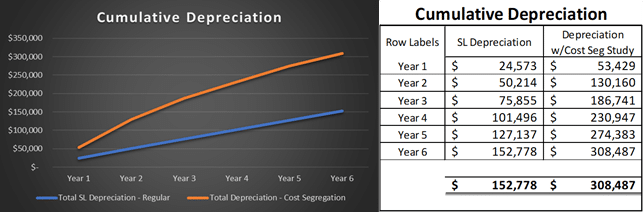
Over 6 years, total depreciation cumulatively grows to $308,487 instead of only $152,778, yielding tax savings of $92,487, more than double the standard method!
NPV Calculation: Is It Worth It?
Let’s calculate the NPV of tax savings over 5 years, assuming a 5% discount rate (a common rate reflecting the time value of money).
- Standard method: $7,692 annually
NPV = $7,692 x [(1 – (1 + 0.05)-5) / 0.05] = $33,366 - Cost segregation:
Year 1: $20,615 / (1.05)1 = $19,633
Year 2: $20,615 / (1.05)2 = $18,698
Year 3: $20,615 / (1.05)3 = $17,807
Year 4: $20,615 / (1.05)4 = $16,959
Year 5: $20,615 / (1.05)5 = $16,151
NPV = $89,248
Difference: $89,248 – $33,366 = $55,882 in additional value over 5 years.
Tax Implications at a 30% Rate
At a 30% tax rate, every dollar of depreciation saves you $0.30 in taxes. Cost segregation amplifies this early on:
- Year 1 savings: $16,029 vs. $7,692, an $8,337 boost (Cost Seg Study & no Bonus Depreciation)
- Year 1 savings: $80,529 vs. $7,692, a $72,837 boost (Cost Seg Study & Bonus Depreciation)
- Catch-up later: After 5 years, the standard method keeps chugging along, while cost segregation deductions taper off. But the early savings can be reinvested.
(When you sell, some of this depreciation can be recaptured. See “A note on depreciation recapture” below.)
Cost Segregation and Depreciation: Bonus Depreciation Explained
Cost segregation and depreciation go hand in hand, and bonus depreciation is what can make the results especially strong.
Bonus depreciation lets you deduct a large share of a qualifying asset’s cost in the first year instead of spreading it out. It generally applies to property with a recovery period of 20 years or less. That means the building itself (27.5 or 39 years) doesn’t qualify, but the 5-, 7-, and 15-year components found in a cost segregation study generally do.
Under the One Big Beautiful Bill Act, 100% bonus depreciation was made permanent for qualifying property acquired after January 19, 2025. Property acquired before that date falls under the older phase-down rules, so the year you bought or placed the property in service matters. Your CPA can confirm what applies to you.
Put simply: a cost segregation study finds the shorter-life parts of your building, and bonus depreciation may let you deduct those parts right away.
For a closer look at how the new law treats rental property, read our note on the One Big Beautiful Bill and 27.5-year residential rental property.
Residential Cost Segregation: Rentals and Short-Term Rentals
Cost segregation isn’t just for office towers and factories. Residential cost segregation works for apartment buildings, single-family rentals, and multifamily properties too.
The building itself is still depreciated over 27.5 years, but a study can identify components that qualify for shorter lives, such as:
- Flooring like carpet and vinyl
- Cabinets, countertops, and appliances
- Decorative lighting and fixtures
- Landscaping, fencing, sidewalks, and other site improvements
Those reclassified parts may qualify for bonus depreciation, even though the building itself does not.
Short-term rentals (like vacation homes rented by the night) can be treated differently. Depending on the average length of a guest’s stay, a short-term rental may be depreciated as commercial (39-year) property rather than residential (27.5-year) property, and how much of the deduction you can use depends on how involved you are in running it. These rules are worth reviewing with your CPA before you order a study. Here’s our single-family home and short-term rental overview (PDF).
See all the property types we serve, from multifamily and hotels to medical offices and cold storage.
What Does a Cost Segregation Study Cost?
Every property is different, so the fee for a study depends on the work involved. The main factors are:
- Property size and type. A large hotel or manufacturing plant has far more components to identify than a small rental.
- Site visit or desktop review. Some properties call for an on-site inspection; others can be reviewed from photos, plans, and records.
- Documentation available. Clear closing statements, appraisals, and construction cost records make the work more efficient.
- Number of properties. Owners with several buildings can often have them studied together.
- Look-back work. Studies on property placed in service in earlier years may involve additional schedules for your CPA.
The best way to find out whether a study makes sense for your property is to start with our free benefit analysis. It gives you an estimate of the potential benefit for your specific property before you commit to anything. Prefer to talk it through? Call us at 908-459-8377.
Who Should Get a Cost Segregation Study?
Cost segregation tends to work best for:
- Owners who recently bought, built, or renovated a commercial or residential rental property
- Owners who bought in past years and never had a study done
- Taxpayers with income to offset, since bigger deductions help most when you have taxes to reduce
- Owners planning to hold the property for several years
- Properties costing $150,000 or more per property
It may be less useful if you plan to sell soon, if you don’t have taxable income the deductions can offset, or if the property is mostly land.
A note on depreciation recapture
Cost segregation isn’t magic. It’s smart tax planning, and it comes with one trade-off to understand. When you sell a property, some of the depreciation you claimed can be “recaptured” and taxed. Gain tied to the shorter-life components is generally taxed as ordinary income, and gain tied to the building’s depreciation can be taxed at a rate of up to 25%. For many owners, the value of having the money now still outweighs this later cost, and planning tools such as a 1031 exchange may defer it. Your CPA can run the numbers for your situation.
Cost Segregation FAQ
Is cost segregation legal?
Yes. Cost segregation is a long-established, IRS-recognized method of identifying property for depreciation. The IRS publishes its own Cost Segregation Audit Techniques Guide, which describes what it considers a quality study.
Does a cost segregation study increase my audit risk?
A study doesn’t change the rules; it applies them more accurately. What matters is quality. A well-documented, engineering-based study that follows the approach described in the IRS guide gives your CPA solid support for every number on the return.
Can I do a study on a property I bought years ago?
Often, yes. If you’ve owned a property for a few years and never had a study, your CPA can generally “catch up” the depreciation you missed in the current year by filing IRS Form 3115 (Application for Change in Accounting Method), without amending prior returns.
Does cost segregation work for residential rental property?
Yes. The building stays on a 27.5-year schedule, but components like flooring, appliances, fixtures, and site improvements can often be moved to 5-, 7-, or 15-year lives.
What’s the difference between “cost segregation” and “cost seg”?
Nothing. “Cost seg” is just the shorthand many investors and CPAs use.
Do I need my CPA involved?
Yes. We prepare the study, and your CPA uses it to file. We’re happy to work directly with your accountant. CPAs and advisors can also learn about our Referral Partnership Program.
The Bottom Line
A cost segregation study speeds up depreciation so you get more of your tax benefits now instead of waiting decades. If you own, bought, built, or renovated a property, it’s worth a closer look, and a conversation with your accountant.
Get your free cost segregation benefit analysis or call our office at 908-459-8377 or Anson’s cell at 720-690-6048.